

Emotions and feelings: understanding the difference
Emotional life is often described using broad and imprecise words such as “bad,” “stressed,” or “overwhelmed.” Yet psychological research suggests that the ability to distinguish emotional states more precisely plays an important role in emotional regulation, resilience and decision-making.
A useful starting point is the distinction between emotions and feelings. Although the two terms are often used interchangeably in everyday language, they refer to slightly different processes.
In contemporary psychology and neuroscience, emotions are generally understood as relatively fast, automatic responses produced by the nervous system in reaction to internal or external events. They involve physiological activation, changes in attention and tendencies toward action.
Feelings, by contrast, are the subjective experience and interpretation of those emotional processes. They emerge when the brain integrates bodily signals, perception, memory and meaning. In other words, emotions are largely physiological and adaptive responses, while feelings are the conscious experience that arises from them.
For example, an increase in heart rate, muscle tension and vigilance may reflect the emotional response of fear. The feeling that follows may be interpreted as anxiety, worry, vulnerability or anticipation depending on context and perception.
“Emotions are not reactions to the world. They are constructions of the brain, created through predictions and concepts.”
— Lisa Feldman Barrett, 2006
Emotional granularity: identifying emotions more precisely
The ability to differentiate emotional states with precision is known as emotional granularity. Instead of experiencing one vague state such as “feeling bad,” a person may recognise whether they feel frustrated, sad, ashamed, lonely, anxious or emotionally numb.
Don’t miss Emotional Numbness: Why avoiding pain also silences joy
These experiences may appear similar at first, but they often signal different needs and therefore call for different responses. A person who recognises sadness may need rest, companionship or grief processing. Someone who recognises anger may need to clarify a boundary. Someone who recognises anxiety may need grounding, sequencing and a reduction of uncertainty.
Emotional precision therefore changes the way regulation happens. Instead of reacting automatically, people can respond in ways that better match the underlying signal carried by the emotion.
“People with higher emotional granularity regulate their emotions more effectively and show lower vulnerability to mood disorders.”
— Smidt & Suvak, 2015
Valence and activation: two key dimensions of emotional experience
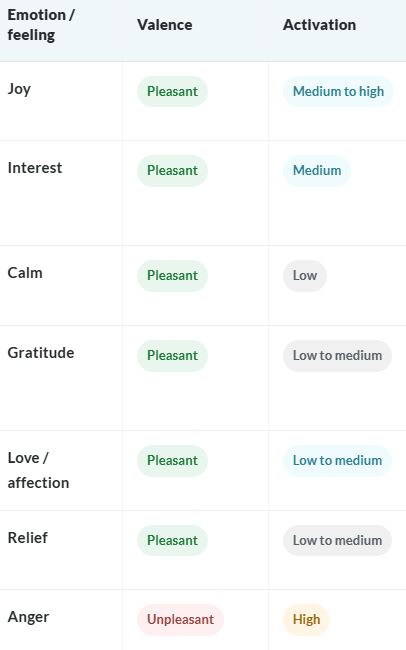
Contemporary psychology often describes emotional states through dimensions such as valence and activation. Valence refers to whether an emotional experience feels pleasant, unpleasant or mixed. Activation refers to the level of physiological arousal in the nervous system.
This distinction helps explain why different emotions require different forms of regulation. Anger and anxiety tend to involve high activation. Sadness, fatigue or hopelessness may involve lower activation. States such as numbness may even reflect a shutdown response in the nervous system.
Likewise, pleasant emotions are not all identical. Joy may be energising and activating, while calm is typically restorative and low-arousal.
Emotional regulation therefore depends not only on what we feel, but also on the level of activation present in the nervous system at that moment.
“The ability to distinguish between negative emotions with greater precision predicts better psychological well-being.”
— Tod B. Kashdan, 2015
From emotional reaction to emotional literacy
The table below offers a practical framework for reading emotional states more precisely. It does not attempt to classify every possible human feeling, and it is not a diagnostic tool. Its purpose is to support emotional literacy.
For each emotional state, the table proposes:
- its general valence
- its typical level of activation
- what it may signal
- a possible pathway for regulation
This kind of map can transform emotional experience from something vague and overwhelming into something more legible and workable. The aim is not to suppress emotions, but to understand them more clearly so that responses become more adaptive and context-sensitive.
Regulation is not suppression
In contemporary research, emotional regulation does not mean eliminating emotions. Instead, it refers to the processes through which emotional responses are modulated, expressed or integrated in ways that remain adaptive.
Sometimes regulation means slowing down. Sometimes it involves movement, expression, social support, boundary clarification or reducing sensory overload. In other situations, it may involve allowing grief or vulnerability to unfold rather than suppressing them.
The more precisely emotional states are recognised, the easier it becomes to choose a response that actually fits the situation.
“Emotion regulation refers to the processes by which individuals influence which emotions they have, when they have them, and how they experience and express them.”
— James Gross, 2002
Emotions are also ecological
At Elevart, emotions are not approached as purely internal events detached from context. Emotional states are shaped by attention, bodily activation, relationships, sensory environments, fatigue, safety and meaning.
Emotional regulation therefore cannot be reduced to mindset alone. It is also ecological. Space, rhythm, sensory input, movement, creative expression and relational quality all influence how emotions are experienced and regulated.
The following table should be read in that spirit: not as a rigid classification, but as a practical orientation tool for recognising emotional states more clearly and responding to them more intelligently.
Elevart Research
Emotional map: emotions, feelings, signals and regulation pathways
Emotional states are not all of the same nature. Some are fast and embodied responses, while others are more reflective, interpretive or mixed.
This table helps distinguish between emotions, feelings and mixed states, while showing their likely valence, activation level, meaning and possible pathways for regulation.
Reading key:Nature describes the type of experience: Emotion – a fast, embodied response. Feeling – the conscious experience and interpretation of that response. Mixed state – a blended or protective experience combining several processes.
Valence indicates the general tone of the experience (pleasant, unpleasant or mixed).
Activation refers to the level of physiological mobilisation, from calm to highly activated.
These categories describe common patterns rather than fixed rules. Context, intensity and nervous-system state influence how emotions and feelings are experienced.
| State | Nature | Valence | Activation | What it may signal | Helpful regulation pathway |
|---|---|---|---|---|---|
| Calm | Emotion | Pleasant | Low | Safety, settling, restoration, reduced threat load | Protect the state, simplify stimulation, rest, silence, slow breathing, sensory regulation |
| Gratitude | Feeling | Pleasant | Low to medium | Recognition of support, nourishment, meaning or relational value | Reflection, journaling, expression, acknowledgment, prosocial action |
| Love / affection | Feeling | Pleasant | Low to medium | Attachment, care, trust, emotional significance, bonding | Presence, reciprocity, co-regulation, warmth, safe contact, verbal expression |
| Relief | Feeling | Pleasant | Low to medium | Threat reduction, pressure release, easing of uncertainty | Pause, decompression, exhale, integration, rest before re-engagement |
| Interest | Emotion | Pleasant | Medium | Curiosity, orientation, motivation to explore, attentive engagement | Focused attention, experimentation, note-taking, exploration, active learning |
| Joy | Emotion | Pleasant | Medium to high | Reward, safety, fulfilment, pleasurable meaning, vitality | Savouring, sharing, gratitude, embodiment, memory consolidation |
| Numbness | Mixed state | Blunted / mixed | Low or shutdown | Protective disengagement, chronic stress, unresolved threat, overload, fatigue | Gentle sensory activation, safe connection, movement, pacing, emotional labeling, no pressure to “feel more” too fast |
| Confusion | Mixed state | Mixed | Low to medium | Conflicting signals, incomplete information, lack of clarity, cognitive disorganisation | Slow down, ask questions, clarify, write things down, reduce ambiguity, postpone unnecessary decisions |
| Hope | Feeling | Pleasant / mixed | Medium | Future orientation, possibility, perceived pathway despite difficulty | Support agency, identify realistic next steps, reinforce meaning, sustain social support |
| Ambivalence | Mixed state | Mixed | Medium | Competing needs, attraction and avoidance, mixed motivations | Differentiate needs, map pros and cons, tolerate complexity, delay premature closure |
| Hopelessness | Feeling | Unpleasant | Low | Collapsed expectation, helplessness, absence of a perceived pathway | Start with a very small next step, restore agency, seek external support, reduce isolation, reintroduce movement |
| Sadness | Emotion | Unpleasant | Low to medium | Loss, disappointment, unmet longing, separation, need to slow down | Allowing, crying, companionship, rest, symbolic expression, meaning-making |
| Loneliness | Feeling | Unpleasant | Low to medium | Lack of meaningful connection, social disconnection, unshared experience | Reach out, seek community, create structured contact, allow small relational risks, co-regulate |
| Grief | Feeling | Unpleasant | Variable | Significant loss, rupture, irreversible change, attachment wound | Ritual, relational support, paced mourning, storytelling, embodiment, time |
| Disgust | Emotion | Unpleasant | Medium | Rejection, contamination, aversion, need for distance, moral or sensory refusal | Distance, discernment, sensory reset, contextual evaluation, boundary reinforcement |
| Guilt | Feeling | Unpleasant | Medium | Perceived harm, responsibility, misalignment with values, need for repair | Clarify responsibility, apologise when needed, take corrective action, distinguish guilt from shame |
| Shame | Feeling | Unpleasant | Medium to high | Threat to belonging, exposure, humiliation, damaged self-image | Self-compassion, precise naming, safe relational repair, contextual reappraisal, reducing self-attack |
| Frustration | Feeling | Unpleasant | Medium to high | Obstacle, blocked goal, mismatch between effort and outcome | Pause, reassess strategy, seek alternatives, reduce perfectionism, regulate activation |
| Anger | Emotion | Unpleasant | High | Boundary violation, injustice, blocked action, unmet need | Pause before acting, physical discharge, boundary clarification, assertive communication, reflection |
| Fear | Emotion | Unpleasant | High | Threat detection, danger anticipation, uncertainty, need for protection | Orienting, grounding, reality-checking, reducing ambiguity, safe support, titrated exposure |
| Anxiety | Feeling | Unpleasant | High | Persistent anticipation, overload, unpredictability, internal alarm without a clear endpoint | Reduce stimulation, name the concern, break tasks into steps, breathe, create external structure, co-regulate |
| Overwhelm | Mixed state | Unpleasant | High or dysregulated | Too much input, excessive demands, insufficient recovery, cognitive-emotional overload | Reduce inputs, prioritise, externalise tasks, orient to body and space, rest, narrow the focus |
References for the emotional regulation table
- Gross, J. J. (2002). Emotion regulation: Affective, cognitive, and social consequences.
- Gross, J. J. (2015). Emotion regulation: Current status and future prospects.
- Posner, J., Russell, J. A., & Peterson, B. S. (2005). The circumplex model of affect: An integrative approach to affective neuroscience, cognitive development, and psychopathology.
- Barrett, L. F. (2006). Solving the emotion paradox: Categorization and the experience of emotion.
- Kashdan, T. B., Barrett, L. F., & McKnight, P. E. (2015). Unpacking emotion differentiation: Transforming unpleasant experience by perceiving distinctions in negativity.
- Smidt, K. E., & Suvak, M. K. (2015). A brief, but nuanced, review of emotional granularity and emotion differentiation research.
- Hoemann, K., et al. (2023). Emotional granularity is associated with daily experiential diversity, growth mindset, and socioeconomic status in adolescents.
- Fernandez, K. C., Jazaieri, H., & Gross, J. J. (2016). Emotion Regulation: A Transdiagnostic Perspective on a New RDoC Domain.